
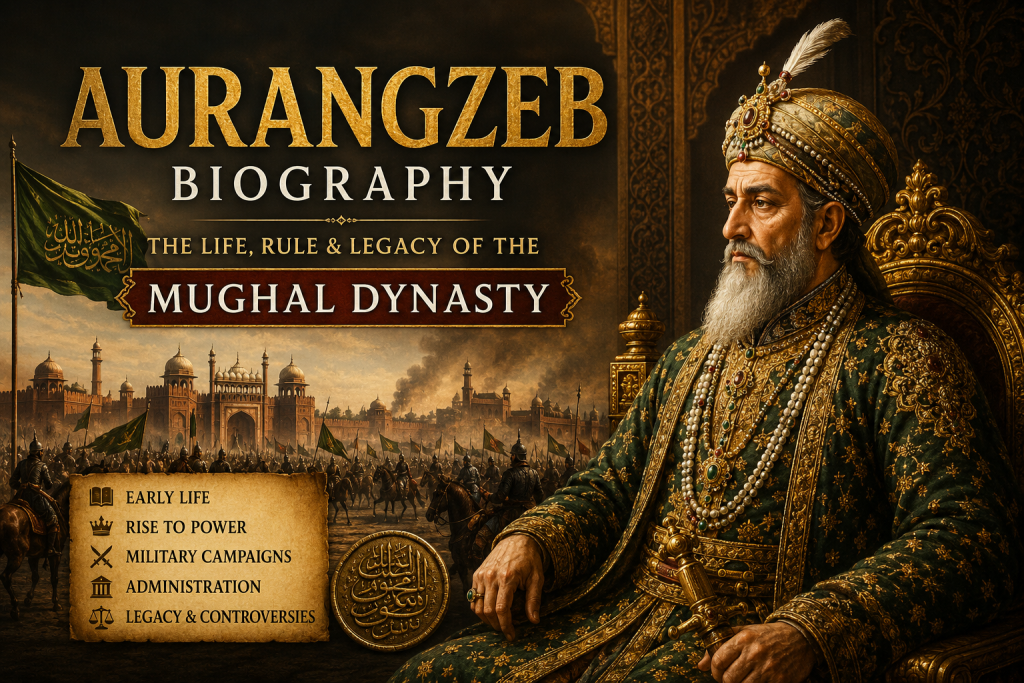

Aurangzeb Alamgir remains one of the Mughal Dynasty’s most debated emperors. He ascended the throne in 1658 at age 40 after a bloody succession war, ultimately ruling for 49 years over some 150 million subjects. During his reign the empire stretched to its greatest extent (about 3.2 million km², roughly the size of modern India). Yet despite these accomplishments, Aurangzeb’s own reflections were surprisingly humble: on his deathbed he wrote “I came as a stranger, and I leave as a stranger”. This post will trace Aurangzeb’s early life, rise to power, major achievements and controversies, and consider how his reign reshaped the fate of the Mughal Empire.
| Detail | Info |
|---|---|
| Full Name: | Muhi-ud-Din Muhammad Aurangzeb Alamgir |
| Born: | 3 Nov 1618 (Dahod, Gujarat) |
| Died: | 3 Mar 1707 (Ahmednagar, India) |
| Father: | Shah Jahan, Mughal Emperor |
| Reign: | 1658–1707 |
| Dynasty: | Mughal Dynasty |
| Major Conquest: | Expansion to India’s largest territorial extent |
| Legacy: | Controversial; seen as devout and austere, yet polarizing |
Image: Aurangzeb holding court in a 17th-century Mughal miniature painting. As emperor, he presided over a vast and diverse empire.
Introduction
Aurangzeb was born on 3 November 1618 into the Timurid royal family of the Mughal Dynasty. He was the third son of Shah Jahan (the builder of the Taj Mahal) and Mumtaz Mahal. In youth Aurangzeb was noted for his piety, fluency in Arabic/Persian and focus on military matters. He served as a provincial governor (in Gujarat and the Deccan) before seizing power. In 1658, amid a brutal war of succession, Aurangzeb defeated his brothers (including Dara Shukoh), imprisoned his ailing father, and took the throne. From the start he styled himself Alamgir I (“Seizer of the World”) and proceeded to expand the empire by “seizing kingdom after kingdom”. By the end of his 49-year reign, he presided over one of the largest empires in human history (roughly 3.2 million km²).
Yet Aurangzeb’s own assessment of his rule was harsh. In his final letters he lamented that he “lacked in rulership” and that his life had “passed in vain”. His final goodbye – “Goodbye, goodbye, goodbye” – to his son reflects a ruler who believed his own legacy was burdened by sin. In studying Aurangzeb, historians weigh his vast territorial achievements and administrative reforms against his strict personal austerity and divisive religious policies. Let’s begin with his rise to power.
Early Life and Rise to Power
Aurangzeb’s upbringing was in the privileged but turbulent environment of the Mughal court. His grandfather Jahangir and father Shah Jahan were known for patronizing the arts and interfaith tolerance (the famous “Mughal syncretism”). Aurangzeb, by contrast, was serious and devout from youth. He learned Islamic law and languages while also training as a soldier and administrator. By his twenties he had won a reputation as a capable but strict governor in provinces like Gujarat and later the Deccan. These experiences hardened him and built his confidence to rule.
When Shah Jahan fell ill in 1657, Aurangzeb seized the moment. After allying with key generals, he routed his brothers in battle (notably defeating Dara Shukoh at Samugarh in 1658). Two brothers died in the fighting, a third fled to Burma, and Aurangzeb even placed his own father under house arrest. He then declared himself emperor, taking the regal title “Alamgir”. From the outset, Aurangzeb’s reign was defined by discipline and expansion. In a 1660s court painting he appears poised, hawk in hand, symbolizing his imperial command.
Expansion of the Mughal Empire
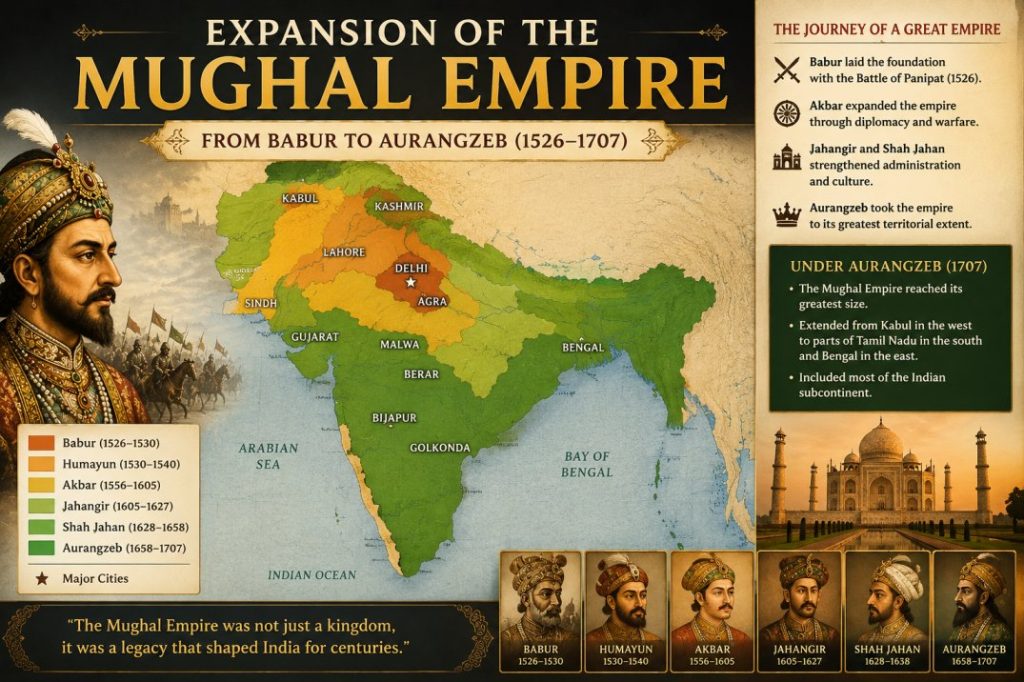
Under Aurangzeb the Mughal Empire reached its maximum geographical size. Loyal generals and governors captured or subdued the last independent sultanates and kingdoms of the subcontinent. Major conquests included:
- Deccan Sultanates: Bijapur (1686) and Golconda (1687) fell to Mughal armies.
- Shivaji’s Maratha Realm: A prolonged guerrilla war in the Deccan pitted Aurangzeb against the emerging Maratha Confederacy (founded by Chhatrapati Shivaji), which only grew stronger despite decades of warfare.
- Regional Rajputs and Others: Some Rajput states remained semi-independent, but others (especially those opposing him) were forced into Mughal alliance or tribute.
By 1707 Aurangzeb’s armies had carried Mughal authority into much of South Asia – from Afghanistan and the Punjab, across the Gangetic plain, to southern India (see map). Image: The Mughal Empire at its peak under Aurangzeb in 1707 (modern-country borders shown). Aurangzeb’s conquests spread Mughal rule nearly across the subcontinent.
However, these military campaigns came at great cost. The Deccan wars alone consumed vast treasury reserves and manpower. Aurangzeb spent roughly 27 years campaigning in southern India, and even relocated his capital to Aurangabad to focus on the Deccan front. The historian Audrey Truschke notes that he seized “kingdom after kingdom” in his reign, but others observe this exhausted the empire. As the UCLA historian Kashinath Singh (Mitchell) writes, Aurangzeb’s “extensive military campaigns – particularly in the Deccan – created a severe financial drain” on the empire.
Comparison: Akbar vs Aurangzeb
| Feature | Emperor Akbar (r. 1556–1605) | Aurangzeb (r. 1658–1707) |
|---|---|---|
| Religious Policy | Promoted tolerance (abolished jizya, supported all faiths) | More conservative: reinstated jizya (1679), banned some Hindu fairs and temples |
| Administration | Inclusive, decentralized (e.g. Zabt land-revenue system) | Centralized, merit-based appointments, strict law enforcement |
| Culture & Arts | Vast patronage (built Fatehpur Sikri, Taj Mahal; advanced music & painting) | Austerity: little new monumental architecture; court arts declined |
| Empire Size | Consolidated Mughal power, limited new expansion | Expanded empire to its greatest geographic extent |
| Legacy | Remembered for unity and cultural flowering | Remembered as devout and effective, but also divisive and polarizing |
This comparison highlights their opposite approaches. Akbar is celebrated for “Sulh-e-Kul” (universal peace) and syncretic rule, whereas Aurangzeb emphasized Islamic orthodoxy and discipline. For instance, Aurangzeb appointed moral censors (muhtasibs) across major cities to enforce Sharia law – banning public alcohol and gambling. He reportedly memorized the Quran and lived simply; unlike Shah Jahan, he showed little interest in grand architectural projects. (One source notes he spent years copying Quranic verses by hand for his own education.) In governance, Aurangzeb cut court expenses and took personal oversight of finances. These policies kept the empire organized but also created tensions among nobles used to more cultural freedom.
Religious Policies: Balancing Piety and Power
Aurangzeb’s reign is most controversial for its religious measures. After the more pluralistic policies of his predecessors, he took a decidedly pious approach. Early in his rule (1668–1669), Aurangzeb banned Hindu religious fairs and new temple construction. He ceased the practice of darshan (public audience) that Akbar had maintained. In 1679 he reimposed the jizya – a per capita tax on non-Muslims – which Akbar had abolished a century earlier. This decree was so significant that even his courtiers protested; one chronicler reports elephants were used to disperse Hindu crowds who marched to Delhi to petition the emperor. Aurangzeb believed these policies honored Islamic law. (Britannica notes that reintroducing jizya followed Quranic injunctions, and that Aurangzeb viewed conversion to Islam as meriting imperial favor.)
These orthodox measures fueled lasting debates. In India, Aurangzeb is often portrayed in political discourse as a zealot who oppressed Hindus. In Pakistan, some see him as a righteous Muslim king. Historically, scholars now urge nuance. As the UCLA historian explains, the record shows discriminatory policies indeed took place – “Hindu religious fairs were outlawed in 1668…and in 1679 Aurangzeb went so far as to reimpose…the jizya or graduated property tax on non-Hindus”. At the same time, many of his actions had political motives. For example, the most famous temple demolition – the Keshava Rai temple at Mathura – was carried out as retaliation after a local revolt, not on religious principle alone. In fact, Aurangzeb continued to grant land and gifts to some Hindu temples (e.g. Someshwar Nath temple in Allahabad).
In summary, modern historians highlight that context matters. Aurangzeb’s policies reflected his own conservative beliefs, but also the realpolitik of rebellion and empire. He certainly made conversion to Islam easier by giving robes and titles to new Muslims. Yet there is scant evidence of a wholesale forced conversion campaign. As one scholar concludes, though Aurangzeb’s reign was “marked by austerity”, many popular narratives (like the idea that temples were wantonly destroyed en masse) oversimplify the historical record. Today’s researchers try to untangle myth from reality: for instance, Audrey Truschke emphasizes questioning simplistic labels, focusing on what archival sources actually say.
Aurangzeb’s Personal Life and End
Despite ruling with iron discipline, Aurangzeb remained a devout ascetic in private. He is said to have earned a small allowance by stitching prayer caps and copying the Quran himself (anecdotes that illustrate his piety and frugality). He had at least five wives and dozens of children; one son, Bahadur Shah I, ultimately succeeded him. Aurangzeb did not commission any grand tomb for himself. Instead, when he died in March 1707 (in a military camp near Ahmadnagar), he was buried in a simple, unmarked grave at Khuldabad, Maharashtra.
Image: Tomb of Aurangzeb in Khuldabad, Maharashtra. In accordance with his wishes, Aurangzeb was interred in a plain open grave near a Sufi shrine, a stark contrast to the Taj Mahal or Humayun’s tomb.
Aurangzeb’s final days were marked by introspection. He wrote to his sons confessing he had “chosen isolation from God” and feared punishment. These poignant letters reveal a ruler who saw his worldly power as fleeting. After his death at age 88, he was given the posthumous title “Khuld-Makan” (“he whose abode is in eternity”). Yet even in passing, Aurangzeb’s legacy was left very much alive – hotly debated by Hindus and Muslims alike, and by the British who soon eyed his weakened empire.
The Fall of the Mughal Dynasty
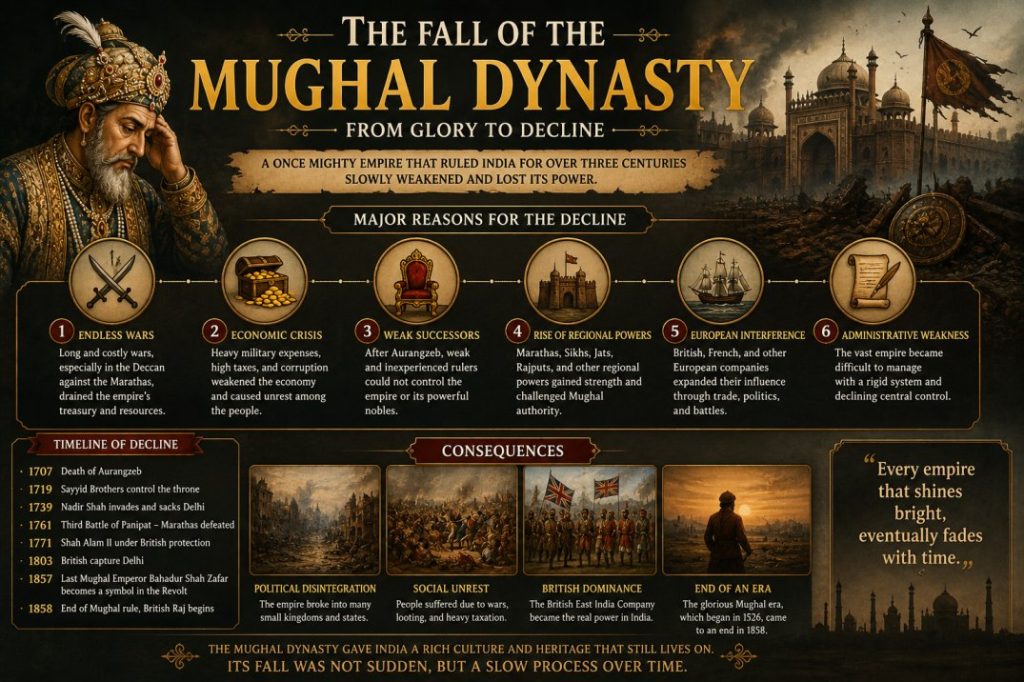
Within years of Aurangzeb’s death, the Mughal Empire began to fragment. The strains of constant warfare and heavy taxation had weakened central authority. Rebellions by the Sikhs (in Punjab), the Jats (around Mathura), and the Marathas (in central India) gained momentum. Aurangzeb’s successors lacked his vigor and faced court infighting. British, French and other European trading companies also exploited the chaos. As one historian notes, “the disintegration of the Mughal Empire followed rapidly after the death of Aurangzeb in 1707”. By the mid-18th century, the empire that Aurangzeb had expanded was but a shadow of its former glory, soon to be absorbed by regional powers and, ultimately, the British.
Legacy: Aurangzeb in History
Aurangzeb remains one of the most polarizing figures in Indian history. To many, he is a symbol of intolerance and the beginning of Mughal decline; to others, a paragon of devotion and just rule. Public memory often simplifies him as the “bigoted” Mughal, but historians urge a balanced view. As Audrey Truschke observes, twentieth-century leaders like Nehru depicted Aurangzeb as a dangerous puritan, saying “he put back the clock” on India’s social harmony. Yet today scholars emphasize studying him in the context of 17th-century empire-building and geopolitics.
In fact, Aurangzeb did leave notable administrative legacies: for example, his reign saw a more efficient land-revenue system and uniform coinage. He also reinforced the integrity of the Mughal legal code (inspired by Islamic law) and is noted for patronizing madrasas (schools). Many Muslims praise him as a righteous Islam-based ruler; many Hindus lament the hardships his wars caused. In South Asian culture, Aurangzeb’s name still sparks debate – from renaming streets to school essays – reflecting how history remains alive.
Ultimately, Aurangzeb’s life shows the complexities of empire. He was a skilled administrator and soldier who vastly enlarged the Mughal realm, yet his zeal and austerity alienated parts of his multi-faith empire. His story invites reflection: how do beliefs shape governance? Can an empire of 150 million people be held together by force? Today’s scholarship suggests that while Aurangzeb was undeniably devout and authoritarian, many of the myths about him (the number of temples destroyed, or forced conversions en masse) are exaggerated. He was, as Truschke puts it, “a live wire of history that sparks fires in the present day” – a ruler who defined an era but whose true legacy requires careful study.
Key Takeaways
- Longest-Reigning Mughal: Aurangzeb ruled for nearly 50 years (1658–1707), longer than any other Mughal emperor.
- Empire Builder: He expanded the Mughal Empire to its greatest extent, covering most of South Asia.
- Orthodox Rule: Aurangzeb enforced strict Islamic laws (reintroducing the jizya tax in 1679 and banning certain Hindu practices), which remains his most controversial legacy.
- Personal Piety: Unlike his opulent predecessors, he lived austerely (even copying the Quran) and was buried in a simple open tomb as per his wishes.
- Complex Reputation: Modern historians stress nuance: he was neither a one-dimensional zealot nor a saintly hero, but a powerful ruler shaped by his times.
Interesting Facts
- Aurangzeb carried the Kohinoor diamond in his treasury.
- He reportedly ordered no silver in his tomb (unlike the Taj Mahal’s white marble) and insisted on a grass covering on his grave.
- The name “Aurangzeb” means “ornament of the throne” in Persian.
- He was the last of the great Mughal emperors; after his death the dynasty steadily declined.
Conclusion
Aurangzeb’s biography is a study in contrasts. On one hand, he was a brilliant strategist and disciplinarian who led the Mughal Dynasty to its zenith. On the other, his reign’s relentless wars and strict policies arguably accelerated the empire’s later collapse. In the end, Aurangzeb’s life teaches us that history often defies simple judgments. Modern research – armed with Persian chronicles, farmans (royal orders) and scholarly analysis – paints Aurangzeb as a product of his age: a deeply religious ruler facing the immense challenges of a far-flung empire. Whether you view him as a visionary or a zealot, one thing is clear: Aurangzeb’s rule fundamentally shaped the subcontinent’s trajectory.
What do you think? Feel free to share your thoughts in the comments. If this post resonated with you, subscribe for more deep dives into Mughal history and related topics!
Frequently Asked Questions
- Who was Aurangzeb?
Aurangzeb (1618–1707) was the sixth Mughal emperor. He expanded the Mughal Empire to its largest size and ruled for 49 years. - Why is Aurangzeb controversial?
His strict religious measures (like reinstating the jizya tax on non-Muslims in 1679) and long wars make him a polarizing figure. Some view him as an austere, justice-minded ruler; others criticize him as intolerant. - How did Aurangzeb’s policies differ from Akbar’s?
Akbar promoted religious tolerance (abolishing the jizya, inviting diverse faiths at court), whereas Aurangzeb emphasized Islamic orthodoxy (reimposing the jizya, banning certain Hindu practices). - Where is Aurangzeb buried?
In accordance with his wishes, Aurangzeb was interred in a simple, open-air grave at Khuldabad in Maharashtra, unlike the grand mausoleums of other Mughal emperors. - Did Aurangzeb kill the Sikh Guru Tegh Bahadur?
Yes, Aurangzeb ordered the execution of Guru Tegh Bahadur in 1675. This is often cited as an example of his harsh treatment of non-Muslims. - What happened after Aurangzeb’s death?
Aurangzeb died in 1707 and was succeeded by his son Bahadur Shah I. The Mughal Empire quickly weakened, as factions fought for the throne and various regions (Marathas, Sikhs, Afghans, etc.) asserted independence.
